One step ahead at Japan IT Week: Business card scanners and data utilization strategies
At large exhibitions like Japan IT Week, success depends not on the number of leads collected, but on how effectively they are processed and acted on through a structured workflow.
1. What is Japan IT Week Spring 2026?

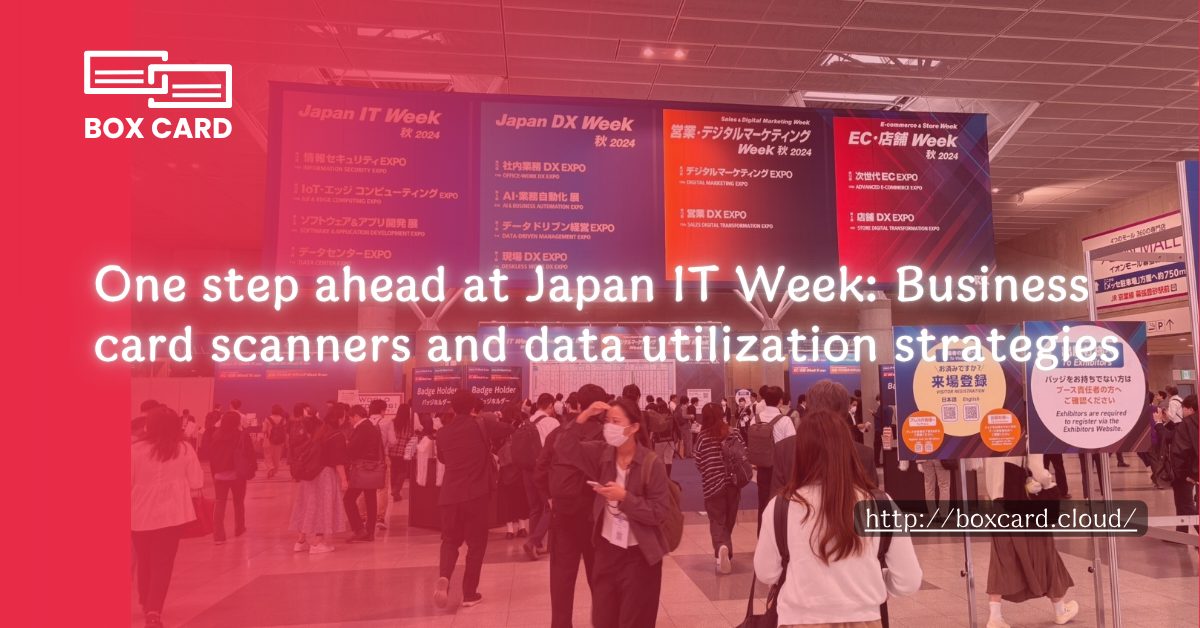
Japan IT Week Spring 2026, scheduled to take place from April 8 to 10 at Tokyo Big Sight, is one of Japan’s largest IT and digital transformation exhibitions, bringing together approximately 1,100 exhibitors across key sectors such as AI, software development, IoT, cybersecurity, and cloud computing, with an expected attendance of around 60,000 visitors.
Given the scale and density of interactions, the event creates a unique business environment in which a high volume of leads can be generated in a very short period of time, while at the same time requiring exhibitors to operate with speed and precision in order to convert those leads into actual business opportunities.
2. Why Japan IT Week Matters More Than Ever
The importance of Japan IT Week has increased significantly in recent years due to structural changes in the Japanese IT market, which is currently being shaped by several major trends:
・The rapid and practical adoption of generative AI across industries
・The acceleration of digital transformation (DX) initiatives and cloud migration
・The growing emphasis on advanced security models such as zero-trust
As a result of these trends, corporate IT investment has shifted from a phase of exploration and information gathering to one of execution and implementation, meaning that many attendees at the exhibition are no longer passively collecting information but are actively comparing solutions and making decisions.
This shift has fundamentally changed the role of exhibitions:
・From information gathering → to decision-making platforms
・From networking opportunities → to pipeline generation environments
In a highly competitive setting with over 1,000 exhibitors targeting similar audiences, the ability to respond quickly and utilize data effectively becomes a decisive competitive advantage.
3. Common Challenges Exhibitors Face
Despite the significant opportunity, many companies struggle to convert exhibition leads into tangible business results, often due to operational inefficiencies rather than strategic shortcomings.
Lead Management Bottlenecks
While collecting business cards is relatively straightforward, processing them efficiently at scale presents a major challenge.
・Data entry is delayed until after the event
・Information remains unstructured or incomplete
・Follow-ups are postponed or missed entirely
As a result, even high-quality leads may never be properly engaged.
Lack of Lead Prioritization
A business card alone provides limited insight into the actual value of a lead, making it difficult to determine:
・The level of interest
・The urgency of the need
・The decision-making authority of the contact
Without this context, sales teams are unable to allocate their time and resources effectively.
Information Silos
When business cards are managed individually by team members rather than within a shared system:
・Data becomes fragmented across the organization
・Collaboration between sales and marketing teams is reduced
・Overall efficiency of the sales process declines
Delayed Follow-ups
・Timing plays a critical role in lead conversion.
・Interest is highest immediately after the interaction
・Delayed outreach leads to rapid decline in engagement
These issues are not isolated problems but are typically symptoms of a deeper issue: the absence of a well-defined operational framework.
4. The Real Cause of Opportunity Loss

In most cases, the root problem is not the volume of leads generated but the structure through which they are managed and utilized.
A common failure pattern includes:
・Business cards are not digitized promptly
・Data is not integrated into the sales workflow
・Information remains siloed and inaccessible
Under these conditions, leads exist in theory but cannot be effectively leveraged in practice.
Time is the most critical variable in this process.
・Peak engagement occurs immediately after the interaction
・The effective conversion window is within 48 hours
Failing to act within this window significantly reduces the likelihood of conversion and increases the risk of losing the lead to competitors who respond faster.
5. The Changing Role of Business Cards
The role of business cards in exhibitions has evolved significantly.
・Traditional perspective: Business card exchange represents the goal
・Modern perspective: Business cards serve as the entry point for data
In this context, success is no longer measured by the quantity of cards collected, but by the efficiency and speed with which that information is transformed into actionable insights.
Modern exhibitions have effectively become environments where a company’s data execution capability is tested.
6. A Practical Workflow for Exhibition Success

Organizations that consistently achieve strong results tend to rely on simple, repeatable operational processes that can be executed under pressure.
Before the Event
Preparation plays a critical role in determining success.
・Define clear target customer profiles
・Develop structured conversation frameworks
・Establish a lead management workflow in advance
Essential tools include:
・A business card scanning application
・Mobile devices such as smartphones or tablets
・Cloud-based storage or collaboration tools
・CRM systems or lead management sheets
・Note-taking tools for capturing context
・Portable chargers to ensure uninterrupted operation
During the Event
Execution speed is key during the exhibition.
・Scan business cards immediately upon receiving them
・Record conversation details and lead “temperature”
・Share data with the team in real time whenever possible
The ability to process information on-site directly impacts post-event efficiency.
After the Event
The post-event phase is where most opportunities are either realized or lost.
・Initiate follow-ups within 24 hours
・Prioritize leads based on potential value
・Assign leads to the appropriate sales representatives
At this stage, success depends on maintaining both speed and accuracy.
7. What to Look for in a Business Card Management App
When selecting a business card management app for exhibition use, practicality and usability are more important than feature complexity.
Criteria | Importance |
| Simplicity | Enables immediate use without training |
| Speed | Supports high-volume processing without delays |
| Real-time capability | Allows instant data capture and access |
| Team sharing | Facilitates collaboration across teams |
Tools that are overly complex often fail in real-world exhibition environments where speed and ease of use are critical.
8. BoxCard: A Simple and Efficient Solution
“Business card apps sound useful, but they’re often complicated, slow, or eventually require payment.”
If you’ve ever felt this way, BoxCard is a great option to consider.
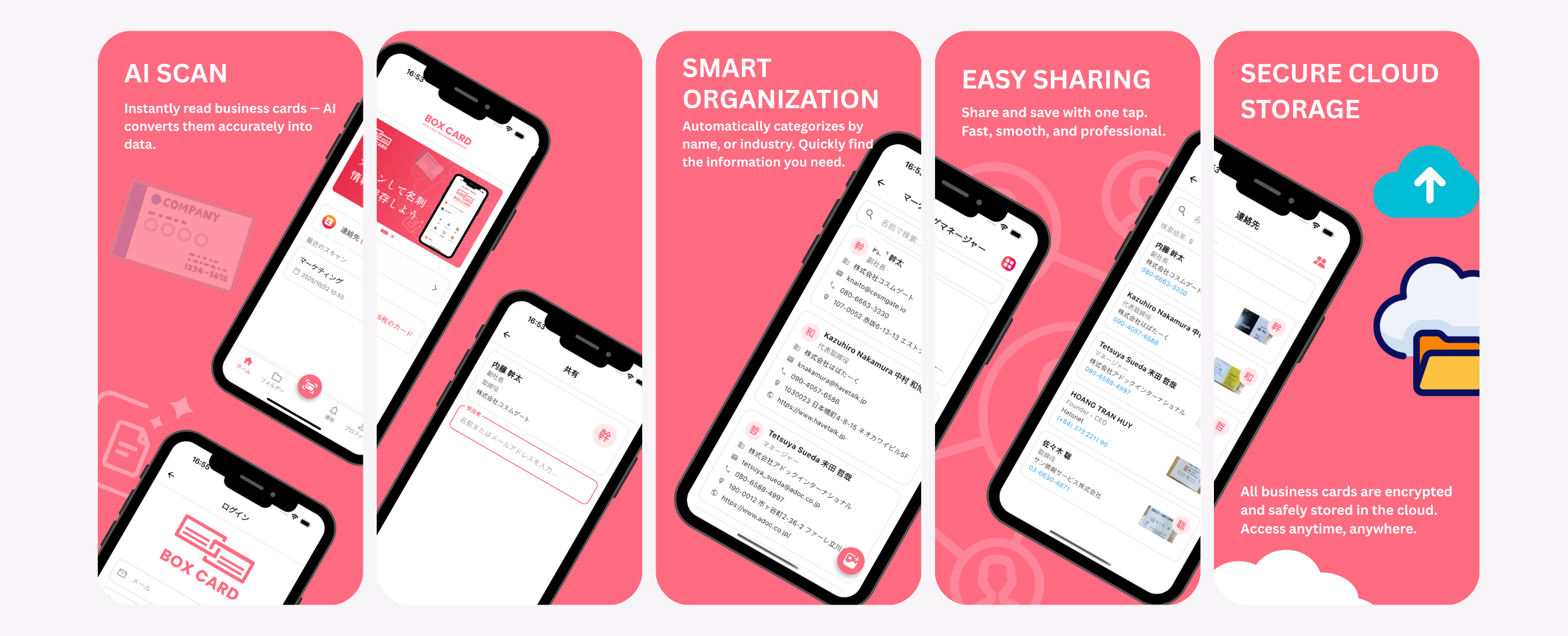
Boxcard is designed with three key strengths in mind: simplicity, lightweight performance, and free access, making it easy for anyone to get started right away.
・Easy to use: Intuitive interface with no complicated setup
・Lightweight and fast: Smooth performance without lag
・Free to use: Core features available without hidden costs
・Multilingual support: Supports English, Japanese, Vietnamese, Korean, and Chinese (Simplified & Traditional)
What Makes BoxCard Different?
Many business card management apps offer advanced features but come with trade-offs such as high costs, complex interfaces, or heavy performance.
BoxCard takes a different approach by focusing on essential functionality with a seamless user experience:
・Streamlined workflow with minimal setup
・Fast scanning, organizing, and searching
・Core features fully accessible without requiring payment
As a result, BoxCard stands out by offering a balance between usability, performance, and cost-efficiency.
This makes it especially useful for professionals handling multilingual business cards or working in international environments.
Who Should Use BoxCard?
・Beginners looking for a simple solution
・Users who want a free and efficient tool
・Professionals managing multilingual contacts
・Anyone who prefers lightweight and easy-to-use apps
👉 Download BoxCard now on the App Store or Google Play and start managing your business cards more efficiently.
At events like Japan IT Week, the difference between success and missed opportunity lies not in the number of business cards collected, but in the ability to transform those cards into structured, actionable data within a limited timeframe.
High-performing companies distinguish themselves by digitizing information immediately, enabling seamless team collaboration, and executing rapid follow-ups based on clear prioritization.
By combining a well-designed operational workflow with efficient tools, organizations can turn raw leads into valuable business assets and maximize the return on their exhibition investment.